
Why Referrals Are Killing Your Cremation Business
Word of mouth is the best marketing that exists. No one argues with that.
A family that was treated with care will tell their friends. A hospice coordinator who trusts you will send families your way for years. A local clergy member who knows your name will recommend you without hesitation. These relationships are built on real trust, and that kind of trust sells better than any ad ever will.
But here's the thing. Relying on referrals (word of mouth recommendations) alone is a growth strategy with a ceiling. And for most funeral homes today, that ceiling is getting lower.
Let's Start With an Honest Story
Last week I spoke with a funeral home owner in Indiana. He took over the family business in 1979, doing 40 arrangements a year. By 2025, through decades of community work, relationship building, and a genuine reputation for care, he had grown to 220 cases a year.
That's remarkable. 46 years of showing up for his community, and it paid off.
The math works out to about 3.9 more arrangements per year, or roughly 3.78% annual growth. Slow, steady, real.
Then last year, a family legal dispute forced him to close 3 of his 5 locations. Overnight, he went from 220 cases down to 150.
He lost 70 yearly cases. Roughly 18 years of word-of-mouth growth, in a single year.
At 3.8 cases per year, relying on referrals alone, it would take him approximately 18 years to get back to where he was.
That's not a criticism of how he built his business. It's just the reality of how slow organic community growth works when it's your only lever.
Why Referrals Work So Well (And Why That's Not the Whole Story)
Referrals work because trust does the selling for you.
When a hospice nurse recommends you to a family, they're not shopping around. When a past family tells their neighbor to call you, the decision is nearly made before the phone rings. That's powerful.
But there's a catch: you can't control it.
You can't speed it up when you need more cases. You can't turn it on in July when things go quiet. And you can't rebuild it quickly when something breaks — like a staff change at a key hospice, a single complaint that spreads, or a legal dispute that closes your locations.
Referrals come when they come. That's always been the tradeoff.
The Passive Growth Problem
Here's the deeper issue. When referrals are your only strategy, you're not really running a growth plan. You're running a waiting plan.
You wait for past families to mention you. You wait for hospice coordinators to stay in their jobs. You wait for the clergy to keep sending people your way. All of it is outside your control.
Most funeral home owners we speak with want to grow. They want more cases, more stability, more flexibility to plan ahead and serve their community for generations to come. But without a system that actively brings in new inquiries, wanting isn't enough. There's nothing to act on.
The funeral homes that grow consistently — year over year, in any season — have figured out how to generate interest, not just receive it.
The Cremation Shift Makes This More Urgent
Here's something that often gets overlooked in this conversation.
Cremation rates in the US have been rising steadily for years, and in many markets they're now above 60%. Each percentage point of drift toward cremation typically means lower revenue per case, sometimes significantly lower compared to a traditional funeral service.
That means even if your case volume stays flat, your revenue may be falling. You now need more inquiries just to maintain what you have.
Word of mouth can't solve this. You can't ask your referral sources to send you more families. You can't stimulate more recommendations when you need a busy month. The timing is entirely out of your hands.
A funeral home losing 5–10% of revenue per year to the cremation shift — while relying on organic word-of-mouth growth of 3–4% — is quietly falling behind. The numbers don't add up.
Days vs. Years
On the other end of the spectrum: we've watched a brand new funeral home go from opening their doors to handling 251 cases in 120 days using digital marketing.
Not 46 years. 120 days.
That's not the norm, and it's not something to expect overnight. But it shows what's possible when you add active digital marketing to the mix — when families searching online at midnight can actually find you, when you show up when someone types "cremation services near me", when your phone rings because you made it easy to find you.
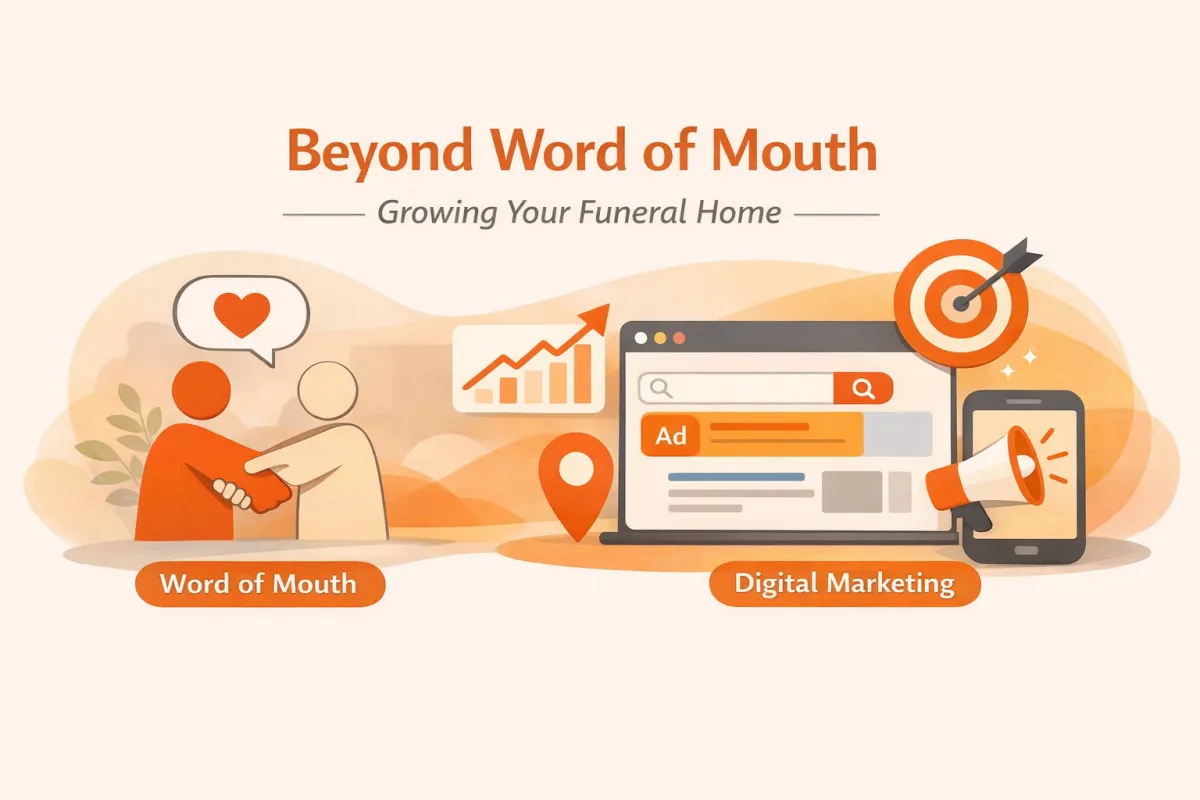
Word of mouth builds trust slowly. Digital marketing creates visibility quickly. The two together are more powerful than either alone.
What Happens When a Referral Source Disappears
This is the fragility that most funeral home owners don't think about until it's too late.
Hospice staff changes. Policy updates shift referral patterns. A new manager comes in with a different philosophy. What felt like a reliable relationship turns out to have been dependent on one person, one relationship, one fragile thread.
One funeral director we spoke with watched a hospice referral source that had been sending cases for over a decade go quiet — not because of anything he did wrong, just a staffing change he had no control over.
When your only lead sources are relationships you don't control, that's a real risk.
Referrals as a Foundation, Not a Full Strategy
None of this is an argument against referrals. They're genuinely valuable. You should absolutely keep building those relationships.
But modern funeral homes treat referrals as afoundation— something that adds to the business — not as the entire plan.
The ones that grow consistently also:
Show up in Google search when families are looking at 2 AM
Have a Google Business Profile that builds trust before anyone calls
Use digital advertising to reach families who don't know them yet
Have multiple ways to generate cases — so losing one source doesn't mean losing everything
The pre-need vs at-need distinction matters here too. At-need families search Google. They don't wait for a referral. They need help now, and they'll call whoever shows up.
The Honest Question
If word of mouth stopped tomorrow, if every referral source went quiet at once — how many cases would you get next month?
For some funeral home owners, the answer is nearly zero.
That's not a comfortable place to be. And it doesn't have to stay that way.
The funeral homes that have built systems to attract families directly aren't abandoning their communities or their values. They're just not leaving growth entirely to chance.
The Bottom Line
Word of mouth built the funeral industry. It's built incredible businesses, one relationship at a time.
But the cremation shift is compressing revenue. Referral sources are unpredictable. And organic growth at 3–4% a year — can be wiped out in a single bad event.
The funeral homes that thrive in the years ahead will be the ones that add active marketing to their existing foundation. Not instead of relationships. In addition to them.
Because 18 years is a long time to wait to get back to where you were.
