
How to Use AI to Analyze Competitor Reviews (Funeral Home Edition)
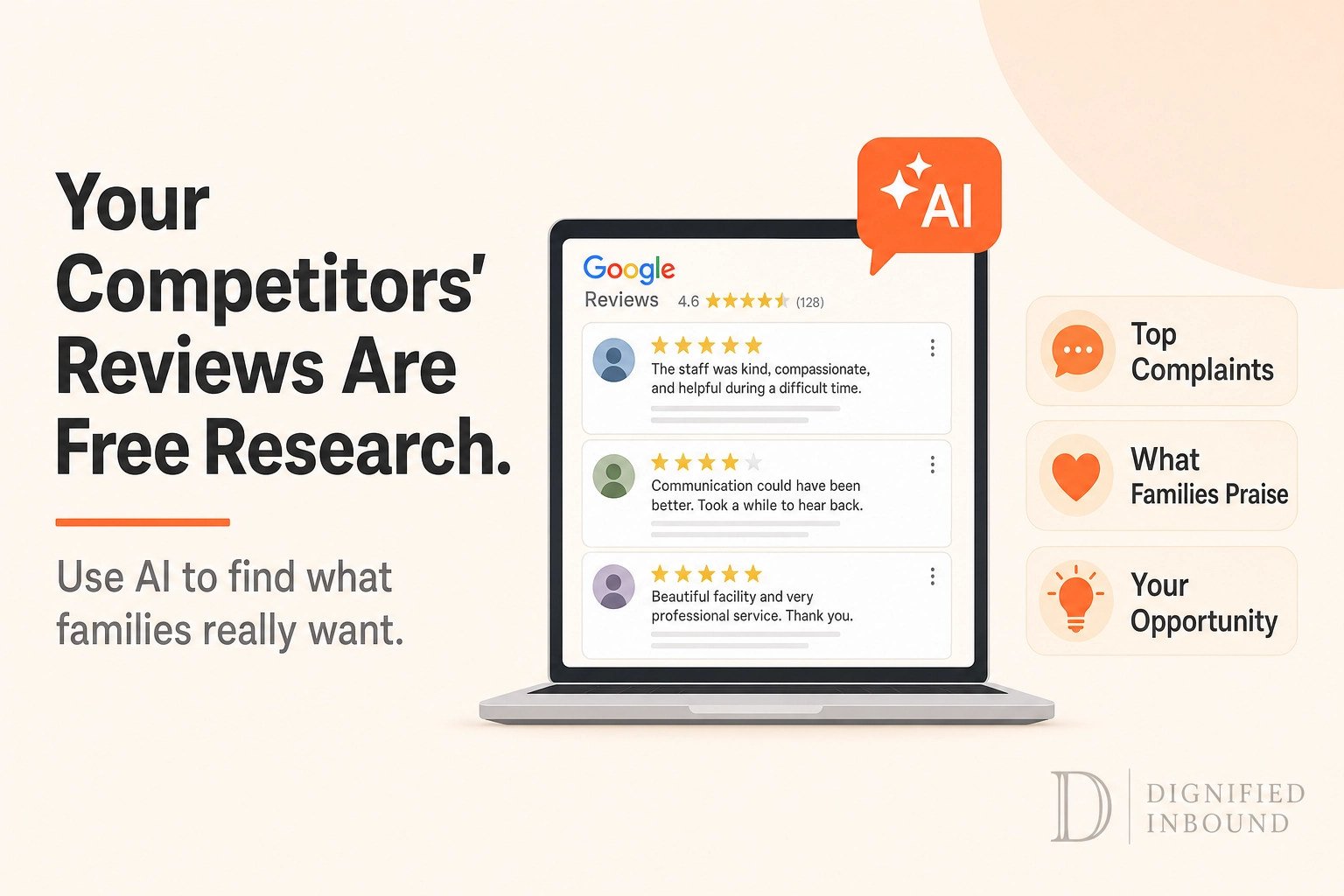
Your competitors' Google reviews are free market research. And most funeral home owners ignore them completely.
Families in your community are writing detailed, honest feedback about what they loved, what frustrated them, and what almost made them choose someone else. They're telling you exactly what matters to them during the hardest moment of their lives.
You're just not reading it.
In the next 30 minutes, you can use a free AI tool to sort through hundreds of reviews, spot patterns your competitors are missing, and walk away with a clear list of ways to improve your business and your marketing.
No spreadsheets. No marketing degree. Just copy, paste, and read.
Why Competitor Reviews Are the Best Marketing Research You're Not Doing
Most funeral home marketing advice tells you to survey your own families. That's useful. But it has a problem: people are polite.
Families who chose you and had a decent experience will usually say kind things. They're not going to tell you the five things that nearly made them call someone else.
Competitor reviews are different. When a family had a frustrating experience with another funeral home, they'll say exactly what went wrong. No filter. No politeness. Just the truth.
That's valuable intelligence.
Across thousands of funeral home reviews, you'll start seeing the same themes come up over and over again. Families praise the same things. They complain about the same things. And those patterns tell you more about what local families actually want than any focus group ever could.
The challenge used to be volume. Reading through 200 reviews one by one takes hours. Now AI can do that in seconds.
What AI Can Pull Out of Competitor Reviews
When you feed a large batch of reviews into an AI tool like ChatGPT, it can spot patterns across all of them at once. Here's what that analysis typically uncovers:
The top complaints: things like long wait times on the phone, feeling rushed during arrangements, unexpected fees, or staff who seemed disconnected from the family's grief.
The top praise: most often things like warmth, clear communication, personal touches, and the feeling that someone genuinely cared.
Staff qualities families notice: specific behaviors like using a loved one's name, following up after the service, or walking families through every step without rushing them.
Gaps your competitors aren't filling: maybe nobody in your market offers flexible payment options, or families keep wishing someone had explained the cremation process more clearly. These gaps are your opportunities.
The Exact 3-Step Process (30 Minutes Total)
Step 1: Collect the Reviews (10 minutes)
Open Google and search for your top three local competitors. Pull up their Google Business Profiles. Start reading through their reviews and copy-paste them into a single document.
Aim for at least 50 to 100 reviews total across all three competitors. The more you collect, the better the patterns. Focus on reviews from the last 12 to 18 months so the data reflects current family expectations.
One tip: include the star rating with each review when you paste it. You want the AI to separate what 1-star reviewers say from what 5-star reviewers say. These are very different conversations.
Step 2: Run the AI Analysis (5 minutes)
Go to ChatGPT— the free version works fine for this. Paste all the reviews you collected into the chat window.
Then paste this prompt exactly:
"Analyze these funeral home reviews and tell me: 1) The top 5 things families complain about most, 2) The top 5 things families praise most, 3) What specific staff qualities or behaviors families mention, 4) Any opportunities you see for a competing funeral home based on these patterns."
Hit send. Within seconds, you'll have a structured breakdown that would have taken you two or three hours to assemble manually.
If you want to go deeper, run a second prompt:
"Based on these reviews, what language and phrases do families use when describing a funeral home they trusted? What words come up most often in positive reviews?"
That second pass gives you the exact vocabulary families use — which is gold for writing your website, your Google Business Profile description, and your ads.
Step 3: Turn the Insights Into Action (15 minutes)
This is the step most people skip. Don't skip it.
Read through the AI's output and write down the three most actionable things you noticed. Then assign each one to a category:
Website update: If families keep mentioning they couldn't find pricing information or couldn't tell what services were included, fix that on your site. Clarity builds trust.
Staff training: If competitors' reviews praise a specific behavior (like calling families the day after the service to check in), make that a standard part of your process.
Marketing language: If families in your area keep praising "no pressure" and "they explained everything," those words belong in your Google ads, your Google Business Profile description, and your homepage.
What You'll Typically Find (Based on Common Review Patterns)
While every market is a little different, these themes come up repeatedly when you analyze funeral home reviews across the country.
What families complain about most:
Feeling like they were being upsold during an already emotional conversation
Confusion about what was included in the price
Slow or unhelpful communication after the initial arrangement
Staff who seemed to be going through the motions rather than genuinely present
Surprises at the final bill
What families praise most:
Staff who remembered small details about their loved one
Clear, upfront pricing with no surprises
Someone who was available and responsive throughout the process
Personal touches — a handwritten note, a follow-up call, flowers on the anniversary
Making a complicated process feel simple
Notice something? Most of the praise is about communication and personal connection. Most of the complaints are about the absence of those same things.
That tells you a lot about where to invest your time.
How to Use This in Your Marketing
Once you have your analysis, the next step is putting it to work. Here's how.
Update Your Website Copy
If families in your area keep complaining that competitor websites are confusing or hide pricing, that's your opening. Write clear, direct copy that answers the questions families actually have. Consider adding a pricing transparency section or an FAQ that addresses the most common concerns you found.
For more on how your website affects your ability to get calls, see Why Your Funeral Home Website Is Losing Cremation Calls.
Sharpen Your Google Business Profile
Your Google Business Profile description is one of the first things families read. Use the language patterns you found in the review analysis to write a description that speaks directly to what local families value. Words like "no pressure," "clear pricing," and "personal care" — if those showed up in your analysis — belong in your profile.
For a full breakdown of what your profile needs to rank in the top 3, see 15 Things Your Google Business Profile Needs to Crack the Top 3 Map Results.
Improve Your Ad Copy
If you're running Google Ads, the language families use in positive reviews is some of the most effective ad copy you can write. You're essentially quoting back what families already believe makes a good funeral home. That resonates. For more on running ads that convert, see Are Google Ads Worth It for Funeral Homes?
Brief Your Team
This is where the real competitive advantage gets built. Print out the top complaints from competitor reviews and walk your team through them. Not to criticize competitors — but to ask: could any of these happen here? What would we do differently?
A staff that understands exactly what families value, and exactly what drives them to leave a negative review, will perform differently than a team that's never thought about it.
A Note on Doing This Honestly
This process is about listening, not copying. You're not looking for ways to imitate what competitors do well. You're looking for what families in your market actually care about so you can serve them better.
The funeral homes that grow consistently are the ones that stay curious about their community. They read the signals. They adjust. They improve.
Reading competitor reviews through AI is just a faster, more organized version of something good business owners have always done: pay attention to what customers say.
Do This Once a Year
Markets change. Staff changes. Competitors change. A review analysis that's over a year old might be missing new patterns that have emerged in your area.
Make this a yearly habit. It takes 30 minutes. It costs nothing. And each time you do it, you'll find at least one thing you can improve.
The funeral homes that dominate their local markets don't wait for families to tell them what they want. They go looking for it.
Now you know where to look.
